people
Members of the lab
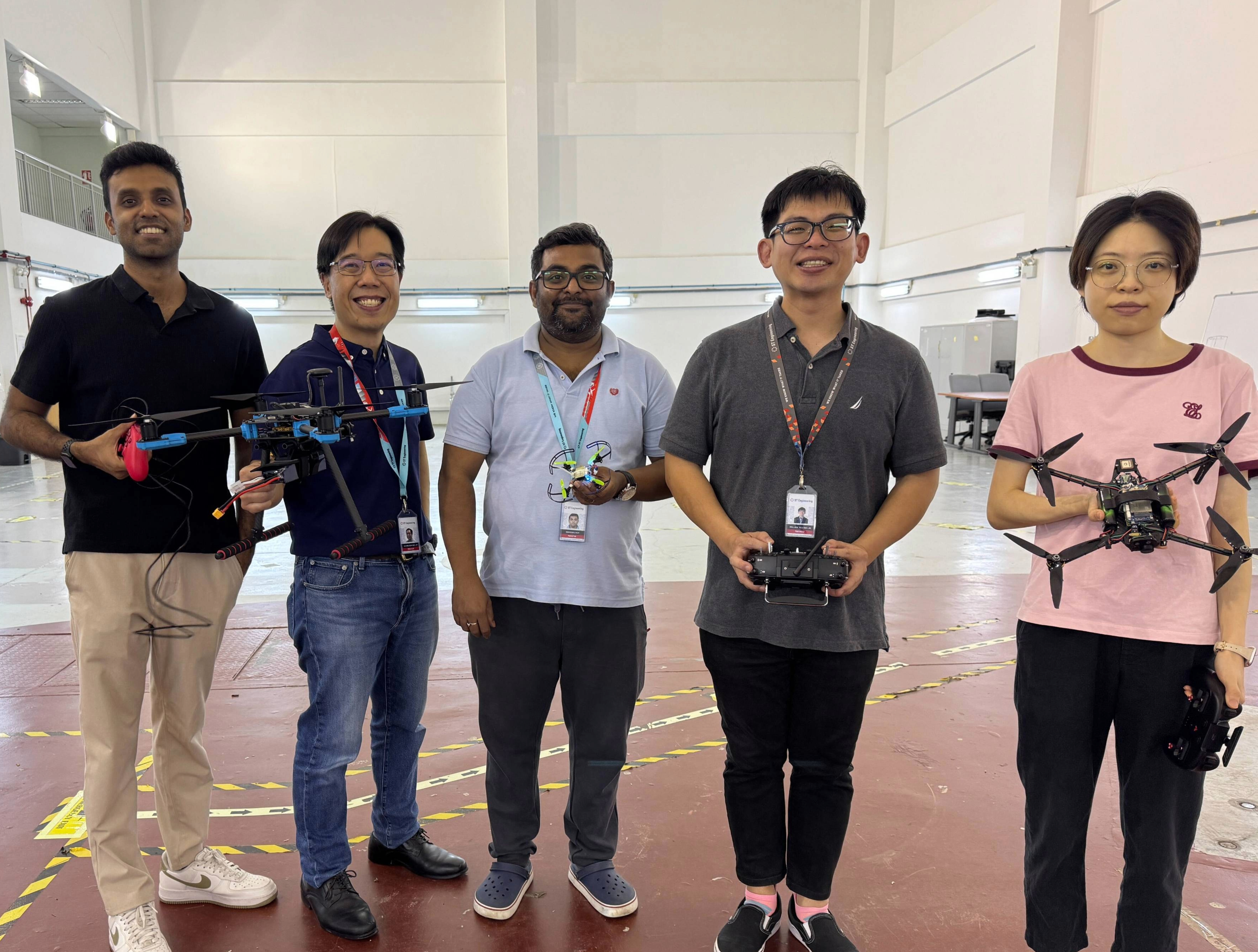
Team NEAR members at Seletar Digital Hub, Singapore

William Teo
Head of Team NEAR@AI.DA-STC
I study how teams of robots learn to coordinate. My core work is strategy and skill learning for multi-robot systems. I work on the strategies teams form, the skills individual robots acquire, and the conditions under which that coordination holds or breaks. This connects to a broader interest in world-action models and how learned policies stay robust inside a team.
I lead NEAR Lab at AI.R STC, ST Engineering. I am also a PhD researcher at the MARMoT Lab at NUS, supervised by Guillaume Sartoretti. Before robotics I trained as a chartered accountant and studied supply chain management at MIT. That background shapes how I think about coordination as an operations problem.

Dibyendu Roy
Principal AI Engineer
Dr. Dibyendu Roy is a Principal AI Engineer at ST Engineering, specializing in distributed AI-driven control architectures for cooperative heterogeneous robotic systems. He earned his Ph.D. in Electrical Engineering from Jadavpur University, where his research focused on decentralized formation control and adaptive navigation of swarm robotic systems. Prior to joining ST Engineering, he served as a Scientist at Agency for Science, Technology and Research (A*STAR), leading research in intelligent navigation and multi-robot collaboration for manufacturing and logistics applications. His work bridges artificial intelligence, control systems, and robotics, translating advanced research into deployable industrial solutions. Dr. Roy has authored numerous publications in leading journals and conferences and holds multiple international patents across the US, Europe, Australia, India, and Japan. His research interests include multi-robot systems, decentralized control, AI-based planning, and physics-aware robotic automation for real-world industrial environments.

Jiaying
Principal AI Engineer
Jiaying holds a PhD from Nanyang Technological University (NTU), specialising in autonomous robotics and intelligent systems. Her work focuses on swarm autonomy, drone systems, SLAM, and learning-based locomotion and whole-body control for advanced robotic platforms.
She operates at the convergence of multi-agent intelligence, embodied AI, and real-world deployment, advancing robust and scalable autonomy in complex environments. Working closely with Institutes of Higher Learning (IHLs) and industry partners, she contributes to the translation of cutting-edge research into operational capabilities. Her interests lie in building resilient, field-ready robotic systems that bridge simulation, experimentation, and deployment at scale.

Krishna
Assistant Principal AI Engineer
Krishna works on research translation and proof-of-concept development, bridging academic research from Institutes of Higher Learning (IHLs) to real-world applications across multiple business units.
His research focuses on embodied AI for robotic manipulation and loco-manipulation in complex, real-world environments. In particular, his interests span:
- Perception and long-horizon planning, developing embodied agents with multimodal perception integrated with task and motion planning under physical and semantic constraints.
- Safe and generalizable embodied learning, leveraging imitation learning, reinforcement learning, and online learning while explicitly reasoning about uncertainty and safety.
- Human and multi-agent collaboration, enabling robots to work seamlessly alongside humans and other agents through intent recognition, shared autonomy, and coordinated decision-making.
He holds a Bachelor’s degree in Electronics and Communication Engineering from VIT Vellore and a Master’s degree in Control and Automation from Nanyang Technological University (NTU).